A letter on the 14th anniversary of my husband Nick's passing, and everything I have learned about carrying things, putting them down, and finally, slowly, coming home.
by Ditas Katague
Saturday, April 18, 2026
I grew up in a Filipino immigrant household, though my family's story doesn't fit the typical immigrant narrative you might expect. My father was what I'd call an intellectual immigrant, he came to the United States to pursue his PhD in Pharmaceutical Chemistry. He didn't come fleeing hardship. He came following his mind. An opportunity opened because of his brilliance, and he walked through it.
My mother came with him. And together they built a life here, rooted in education, in excellence, in the belief that your intellect and your work ethic were the most honest things you could offer the world.
And in that kind of household, the unspoken code was the same as in so many immigrant families: you don't fall apart. You contribute. You honor what your parents sacrificed, and in our case, what they crossed an ocean to build. You hold it together, because that's what love looks like.
So I already knew, from a very young age, what it meant to carry things.
And then at 15, something happened, something I caused, that I carried as the deepest shame of my young life. I won't go into the details out of respect for the people involved, but I can tell you this: I believed I had broken something in my family. And from that moment forward, I was going to fix it. Not by addressing it directly, but by achieving my way out of it.
UC Berkeley. Graduate school at USC on a full scholarship. The Presidential Management Fellowship under President Clinton. Outstanding Graduate Student Award. Every achievement was another brick I was laying, not just building a career, but building a case. A case that I was worthy. That I had made up for what I had done. That my family could finally be proud of me.
And I remember the moment, standing with my father after graduating at the top of my Master’s degree class, and I said to him: "Now Dad, now you can finally be proud of me."
And he looked at me and said: "What? I have always been proud of you. You now need to be proud of YOU."
I didn't know what to do with that. I genuinely didn't know what to do with that. Because if he had always been proud of me, if the shame I had been carrying, the debt I believed I owed, wasn't real in the way I thought it was, then what had I been running from all those years?
I didn't stop to answer that question. Because I didn't know how.
I kept moving. I landed in Washington DC, as a Presidential Management Fellow under President Clinton, working at the US Department of Commerce. And I found myself in the orbit of one of the most extraordinary public servants I have ever encountered: Secretary Ron Brown.
Secretary Brown pulled me aside early on and said something I have never forgotten. He said: "Ditas, if you want to make a difference in the public sector, you need to zig in, and zig out and up. Go to the private sector. Build your earning potential. Fill your career backpack with tools and experience. Then zig back in, at a higher more influential level." He was telling me that the straight line wasn't the path. That the detours were the education.
And I took that to heart. Eventually I would leave government, join Deloitte Consulting in their public sector practice in New York/New Jersey, and begin to understand what he meant. The private sector gave me tools I never would have gotten staying inside government.
But before that, before any of that, there was a moment that stopped me cold and has never left me.
During my fellowship at Commerce, I was lucky enough to rotate into Secretary Brown's policy office on the fifth floor. It was exactly where I wanted to be. Policy. Ideas. Impact. I was in my element.
And then after twelve months, my sponsoring agency, NOAA, called me back downstairs. Back to budget work. Not policy. Budget. And I was devastated. Genuinely devastated. It felt like a step backward. It felt like I was being pulled away from exactly where I was supposed to be.
What I didn't know, what none of us could have known, is that Secretary Brown and so many of his brilliant young staff were about to board a plane. On April 3rd, 1996, that plane crashed into a mountain in Croatia. Secretary Ron Brown and thirty-four others were killed.
Had I not been sent back downstairs to NOAA, had that rotation not ended when it did, I would very likely have been on that plane.
I have sat with that fact for nearly thirty years. The detour I grieved, the reassignment I resented, was the thing that kept me alive.
And I think about Secretary Brown often. His brilliance. His vision. The way he saw something in young people and told them the truth about how to build a life of impact. He didn't get to finish his. And I have spent a great deal of my career asking myself whether I am honoring what he gave me.
That question has never fully left me. And it is part of why I have never been able to take the easy road, or stay still when something inside me said it was time to move.
Kierkegaard wrote that “life can only be understood backwards, but it must be lived forwards”. I have found that to be profoundly, viscerally true. In the moment of each rupture, being sent back downstairs, losing my husband Nick, leaving everything I knew, I could not see why. I was just trying to survive it. But looking back now, I can see the thread running through all of it. Every detour was the path. I just couldn't read the map while I was walking it.
And the next detour came in the form of love. But before love found me, I had to stop looking for it. After my time at Deloitte on the east coast, I decided to transfer back to Northern California. I was in my mid-thirties, and I had quietly, privately, made a kind of peace with the idea that romantic love might not be part of my story. I wasn't bitter about it. I had my career. I had my community. I had my purpose. But I had stopped expecting it.
And so, at 36, I did something that felt both radical and tender at the same time. I bought myself a bungalow in East Sacramento. A cute, sweet little home, just for me. Not waiting for a partner to make it possible. Not holding space for a future that might not come. Just deciding that I deserved a home, and that I was enough to fill it.
I moved in on a Saturday. And on that very first day, in that new home I had bought for myself alone, my phone rang. It was a friend from work. She had someone she wanted me to meet. A blind date. That was Nick.
And what Nick gave me, from almost the very beginning, wasn't just love in the way we usually talk about it. He gave me something I had been quietly starving for my entire life without fully knowing it. He showed me, consistently and tenderly, that I was worthy of being chosen. Not because of what I had achieved. Not because of what I could carry or contribute or accomplish. But simply because of who I was.
I had spent thirty-six years building a case for my own worthiness. Nick just, quietly, made the case irrelevant. And I didn't know, when I answered that phone on the first day in my little bungalow, that I was about to receive the greatest gift and the greatest loss of my life, in the same person.
There was a mentor and dear friend in my life, Catherine Sandoval, who was a California Public Utilities Commissioner, and I had the privilege of serving as her Chief of Staff. Catherine and I worked together for over 9 years. She saw the way I operated. And one day she said to me:
"Ditas, you are like a shark, always on the move."
And I thought, yes. Exactly. That's me. Keep swimming. Keep moving. Because that's how sharks survive, right? They have to keep moving to force oxygen through their gills. Stop swimming, and you die.
And then Catherine said: "But did you know that scientists discovered a species of shark that doesn't have to keep swimming to stay alive? It positions itself in the current, and allows the current to carry it. It still moves. But it isn't the one doing all the work."
And then she looked at me and said: "You need to be that shark, Ditas. Allow your community, your friends, your family, your village, to be the current that keeps you afloat in the times when you are too tired, too weary, to carry the weight yourself."
I heard her. But I'm not sure I was ready to receive it yet.
Because here's the thing about being a first-gen overachiever who learned at fifteen to swim harder, you don't easily trust that the current will hold you. You've been the current for everyone else for so long that being carried feels almost dangerous. Like if you stop moving, even for a moment, everything falls apart.
And then my husband Nick was diagnosed with Stage IV metastatic colon cancer. He was given six to twenty-four months. And I thought, okay. I know how to do hard things. I'll hold it together. I'll be strong. I'll carry this too.
What I didn't understand, what took me completely by surprise, is that grief doesn't care how capable you are. It doesn't reward your track record. It doesn't give you credit for everything you've already survived.
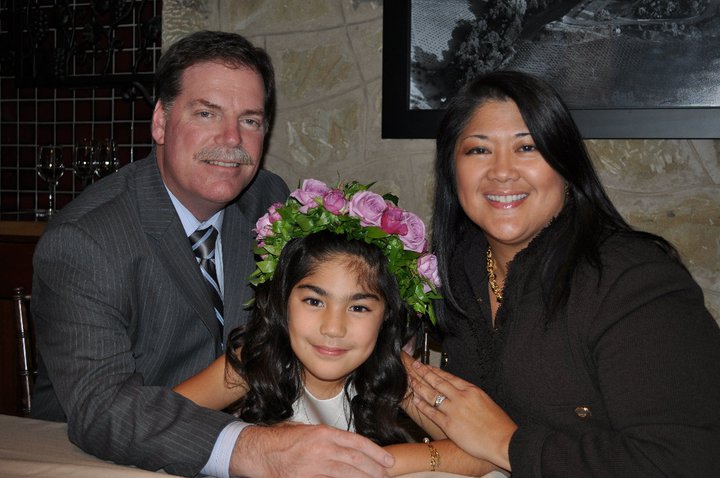
Twenty-eight months after his diagnosis, Nick died. And I was left, a solo parent to Carenna, who was nine years old, with all of these things I had been carrying my whole life, and no more road left to keep walking them down.
Shortly after Nick passed away, I received a package in the mail. It was from Nancy McFadden. Nancy was one of the most brilliant, most quietly powerful women I have ever known. She advised President Bill Clinton, and Vice President Al Gore and was Chief of Staff to Governor Jerry Brown. She was someone who saw people, really saw them, and knew exactly what they needed, often before they did.
Inside the package was a book. Elizabeth Lesser's Broken Open. And tucked inside was a note from Nancy. She wrote: "Ditas, I wanted to reach out earlier, but I'm sending this book that helped me tremendously. I met Elizabeth, and I hope that you find her book helpful."
And I have to be honest with you about something. Because I think it's the most important part of this story. I didn't think Nancy McFadden knew my name.
I mean that sincerely. She was brilliant. She was powerful. She moved in rooms I was still trying to earn my way into. I admired her enormously, but I didn't place myself in her orbit. I didn't see myself as someone she would notice, let alone someone she would think of in the middle of her own battle with cancer.
And when that package arrived, when I read that note, I was genuinely taken aback. Not just moved. Taken aback. Like something had been revealed to me that I hadn't been able to see about myself.
And I remember thinking, did I not know? Did I not understand how my work, my presence, my fighting the good fight in these communities, did I not understand that it registered? That it mattered to people? That I could be seen and cared about by someone like Nancy McFadden?
And that question cracked something open in me that was separate from the grief of losing Nick, though it was all tangled together.
Because here was my father telling me he had always been proud of me, and I couldn't receive it. Here was Secretary Brown investing his wisdom in me, and I catalogued it as career advice. Here was Catherine telling me to trust the current, and I heard it but kept swimming. And here was Nancy McFadden, in the middle of her cancer fight, thinking of me.
And I finally had to ask myself: why have I spent my whole life not believing I was worth seeing?
I think the shame at fifteen had something to do with it. I think the immigrant daughter code had something to do with it. I think thirty years of achieving to prove my worthiness, rather than simply living from it, had everything to do with it.
And it was then that I finally picked up the book Nancy sent me. And Elizabeth Lesser's words landed with the force of everything I had been refusing to feel.
She writes about being broken open. Not broken apart, broken OPEN. And that is exactly what happened to me. Everything I had learned to carry, everything I had suppressed in the name of strength and resilience and first-gen excellence, it cracked wide open.
And what came through the crack was not destruction. It was light.
But I need to tell you how that light actually arrived. Because it wasn't just the painting, though the painting was part of it.
Three months after Nick died, my daughter Carenna was invited to Camp Kesem, a week-long sleep away camp for children impacted by a parent's cancer diagnosis. And when I found out she would be away for five days, something in me thought, I need my own camp.
I had always wanted to go to the Esalen Institute in Big Sur. If you have never been, Esalen is a place where three waters meet, the Pacific Ocean, a freshwater creek, and natural hot springs. And I believe that the flowing of those three waters, the way they move and merge and keep moving, mirrors something about what grief needs. It needs to flow. It cannot be held still.
I saw that Esalen was offering a yoga retreat that same week and signed up, assuming it was the vinyasa practice I had been doing for four years. I didn't read the details carefully enough.
It was Kundalini yoga and breathwork, led by the extraordinary teacher Kia Miller.
I didn't know what Kundalini was. I didn't know what was about to happen to me. I just knew I needed to go somewhere that wasn't my house, wasn't my grief, wasn't the life I was trying to hold together.
What I didn't understand yet was that Esalen was going to hold me instead.
I had been physically caved in for months. Shoulders forward, chest collapsed, unconsciously protecting my heart from any more pain. Grief does that to a body. It makes you small. It makes you brace. It locks your nervous system into fight or flight and keeps it there, because the body doesn't know the difference between a threat that is over and a wound that is still open.
We worked our way through the chakras that week. And on the day we reached the heart chakra, after we had moved and chanted and breathed and gone still, I was lying on my mat.
And something cracked open.
The tears came without warning. And then my whole body started shaking. Not gently. Violently. Like something that had been held under enormous pressure for a very long time was finally, finally being released.
Kia noticed. She came and knelt beside me and placed one hand on my heart and one hand on my shoulder. She didn't speak. She didn't try to stop what was happening. She just held space. She steadied me. She said with her hands: I see you. I have you. You are safe to feel this.
And my heart chakra, which had been so armored, so blocked, so shut down by grief, opened. And I sobbed in a way I had not allowed myself to sob since Nick died.
I had numbed myself so completely in the name of being strong, being capable, being the one who holds it together, that I had forgotten I was also the one who was allowed to fall apart.
Esalen gave me permission. Kundalini gave me the container. Kia gave me her hands.
And that night, I walked outside. It was August, and the sky above Big Sur was completely clear. The Perseid meteor shower was at its peak, and the shooting stars were falling in every direction. And I stood there, still shaking a little, still soft from everything that had moved through me that day, and I could breathe. Really breathe. For what felt like the first time in years.
Everything looked clearer. Sharper. Like a lens that had been fogged for so long I had forgotten what sharp looked like.
And later that week, a reiki master at Esalen asked me to close my eyes and visualize my healing place. And then she asked me to set out a picnic there for my spirit animal.
I saw a green lawn overlooking the ocean. I set out red meat, mangoes, and strawberries. I was fully expecting some kind of land animal to arrive. A bear, maybe. Something strong and sturdy that matched how I thought of myself. And then she asked me to turn around and allow my animal to show up.
When I turned back around, it was a golden owl. An owl that sees through darkness.
I have sat with that image for more than a decade now. Because I think it was the most honest thing I had ever been shown about myself. Not the shark that has to keep swimming. Not the woman who holds everything together. But the owl. The one who sees clearly precisely because she knows how to be still in the dark. The one whose gift is not speed or strength or the ability to carry more than anyone else.
Her gift is vision. In the darkness. When no one else can see. I have gone back to Esalen every year since that first visit. It is my healing place. It is where the waters flow and where I remember that I am allowed to flow too.
And in 2015, after completing my Kundalini teacher training, I bought a gong. And then crystal bowls. And then Tibetan singing bowls. Because I had learned something profound about what sound does to a body that is locked in grief or fear or the kind of chronic stress that comes from decades of swimming harder than you need to.
Sound heals through the vagus nerve. That long, wandering nerve that connects your brain to your heart, your lungs, your gut. The one that governs whether your nervous system is locked in fight or flight, which is where grief and shame and chronic carrying will keep you, or open to rest and digest, which is where healing actually happens.
Chanting, toning, the vibration of a gong moving through a room, these are not mystical experiences separate from science. They are physiological. They are precise. They reset the nervous system at a level that words and willpower simply cannot reach.
I know this because I lived it. Lying on a mat at Esalen, shaking, with Kia Miller's hand on my heart, and the Perseid meteors falling outside.
And I became a teacher because I knew, with complete certainty, that I was not the only one who needed a container safe enough to fall apart in. Who needed someone to place a hand on their chest and say: you are allowed to feel this. Who needed the current of sound to carry them when they were too exhausted to carry themselves.
I started painting too, late into the night, with the Glee soundtrack playing, because that's what my daughter and Nick had watched together, and the music made me feel something when I was otherwise completely numb. I painted in big, bold colors. Not grief colors. Hope colors. I didn't know that's what they were at the time. I just knew I needed to get it out. www.grievingthruglee.com
And that's when I finally began to understand something it had taken me decades to learn. Being capable of carrying things is not the same as knowing how to put them down.
My father told me that night so many decades ago, you now need to be proud of YOU. It took me losing my husband, losing my sense of self, losing the road I had been running down for thirty years, to finally begin to understand what he meant.
Nancy sent me that book from inside her own breaking open. And she passed away in 2018, after her own courageous battle with ovarian cancer. I have never been able to read those words without feeling Nancy's hands on that book.
And I want to say something about grief here. Because I think we get it wrong a lot of the time.
We talk about grief like it has a finish line. Like if you do enough therapy, paint enough paintings, drive far enough across the country, you arrive somewhere called healed. And then you're done.
That has not been my experience.
I am still in my grief journey. More than a decade after losing Nick, I am still in it. Not in the same way. Not with the same rawness. But it is still there, woven into everything, into how I love, into how I work, into why I sometimes still catch myself swimming harder than I need to.
And what has held me through all of it, through Nick's illness, his passing, raising Carenna on my own, every career shift and landing and new beginning, has been my dear friends Kiko, Sam and Nancy Kirshner Rodriguez. And for Carenna - Busti, Claudie, Lanie and Alex have held so much space for us.
They have been a steady, unwavering presence through all of it. They watched Nick get sick. They stood with me after he died. They helped hold me up as I raised our daughter. And every time I faced a new career transition, every time I landed somewhere new and came up smiling and said I'm fine, I'm strong, they saw right through it.
They don't buy the facade. They never have.
And each time I would land on my feet after one of those shifts, they would say something to me that still hits my heart like a knife even now.
They would say: "Ditas, we have no doubt that you will be a great Director, a great government affairs rep, a great lobbyist, a great consultant. But what we want most of all, is for you to feel JOY again."
Joy.
Not success. Not impact. Not the next title or the next achievement or the next thing I could check off the case I had been building my whole life.
Joy.
And every time they say it, something in me breaks open a little more. Because they see me. They have watched me. They have supported me and carried me and been the current underneath me through decades of loss and rebuilding. And they are not fooled by the strength. They are not impressed by the landing.
They are waiting for the joy.
And I think that is what Nancy McFadden was pointing toward when she sent me that book. What my father was pointing toward when he said you now need to be proud of YOU. What Catherine was pointing toward when she told me to stop swimming and trust the current. What Nick showed me every single day when he chose me, not for what I could accomplish, but for who I simply was. What the golden owl was showing me when she turned around and looked at me with eyes that see through darkness.
All of them, in their different ways, at their different moments, were asking me the same question.
Not, what will you achieve next?
But, Ditas, when do you get to feel joy?
I am still working on my answer to that question. I am still in the grief. I am still learning that joy is not something you earn at the end of the hard work. It is something you practice in the middle of it, like painting at midnight, like lying on a mat at Esalen while the meteors fall, like driving across the country with your dog, like finally, finally stopping long enough to let the current carry you.
Kierkegaard wrote that life can only be understood backwards, but it must be lived forwards.
I am still living forwards. And honestly? I'm still learning how.
And here is what I am beginning to understand, fourteen years later, that I could not have seen while I was living through it.
The joy I am searching for and the worthiness I have spent my whole life trying to earn, they are not two separate things.
They are the same thing.
Because you cannot receive joy, real joy, not the performed kind, not the I'm fine, I'm strong kind, but the deep, quiet, unearned kind, if somewhere inside you, you do not believe you deserve to feel it.
I did not believe I was worth seeing. Not by Nancy McFadden. Not by the communities I served. Not even, if I am completely honest, by Nick, though he showed me every single day that I was.
And if you do not believe you are worth seeing, you cannot believe you are worth joy either.
So the work, the real work, the work that no achievement or title or fellowship or award could ever do for me, is this:
Learning to believe that I was worth seeing all along.
Not because of what I carried. Not because of what I built. Not because of what I survived.
But simply because I am here. Because I have loved and been loved. Because I have grieved and kept going. Because I turned around at Esalen and found a golden owl looking back at me with eyes that see through darkness.
Because my father always knew. Because Nick always knew. Because Nancy McFadden knew, even when I didn't think she knew my name.
The joy is not waiting for me at the end of the hard work.
It is here. Right now. In the telling of this story. In the fourteen years of living forwards. In the painting and the gongs and the breath and the shooting stars. In Carenna, who is no longer nine years old and has grown into a brilliant, beautiful young woman despite everything, or maybe because of it.
In you, reading this. Whoever you are. Whatever you are carrying.
You are worth seeing too.
And that, I think, is where joy lives.
Not in the arriving.
But in the finally, fully, belonging to yourself."
Every detour was the path.